Digital Marketing Strategies for Small Businesses: A Practical Guide to Growing Online
In today's competitive business environment, having a good product or service is only part of the equation. Small businesses also need to be visible where their customers spend their time — online.
Whether you run a local salon, restaurant, professional service, e-commerce brand, manufacturing company, or startup, digital marketing can help you reach the right audience, generate leads, build brand awareness, and increase sales.
The good news is that small businesses don't necessarily need massive marketing budgets. With the right strategy, consistent execution, and proper tracking, even a small business can build a strong online presence.
In this guide, we'll explore practical digital marketing strategies for small businesses and how you can use them to grow your brand.
1. Build a Professional Website
Your website is often the first place potential customers visit after discovering your business.
A professional website should clearly communicate:
- What your business offers
- Who you serve
- Why customers should choose you
- Your products or services
- Contact information
- Customer reviews and testimonials
- A clear call-to-action
Your website should also be mobile-friendly and easy to navigate because many customers discover businesses through their smartphones.
For service-based businesses, dedicated landing pages can also help turn advertising traffic into enquiries and leads.
Pro Tip
Don't treat your website simply as an online brochure. Design it with a clear objective — such as generating enquiries, receiving calls, collecting leads, or driving purchases.
2. Focus on Local SEO and Google Business Profile
If you operate a local business, local SEO can be extremely valuable.
When people search for terms such as:
- Digital marketing agency near me
- Best salon in Delhi
- Interior designer in Gurgaon
- Physiotherapist near me
- Marketing agency in Noida
you want your business to have a chance of appearing in relevant search results.
Start by optimizing your Google Business Profile with:
- Accurate business information
- Correct business category
- Updated phone number
- Website link
- Business description
- High-quality photos
- Regular updates
- Customer reviews
- Relevant services
Keep your information consistent across your website and other online platforms.
3. Use Social Media to Build Your Brand
Social media isn't just about posting promotional content.
Small businesses can use platforms such as Instagram, Facebook, LinkedIn, and YouTube to demonstrate expertise, educate customers, showcase products, and build trust.
A strong social media strategy can include:
Educational Content
Share useful information that answers common customer questions.
Product or Service Content
Show how your product or service works and the problems it solves.
Behind-the-Scenes Content
Give customers a look at your team, process, workplace, or production.
Customer Stories
Showcase genuine customer experiences, testimonials, or case studies.
Short-Form Video
Reels and short videos can be useful formats for increasing reach and communicating information quickly.
The key is consistency. Posting occasionally without a strategy usually makes it difficult to build momentum.
4. Invest in Performance Marketing
Organic marketing takes time. Paid advertising can help businesses reach specific audiences more quickly.
Platforms such as Meta Ads and Google Ads allow businesses to target people based on factors such as location, interests, search intent, demographics, and previous interactions.
Depending on your objective, campaigns can focus on:
- Lead generation
- Website traffic
- Product sales
- WhatsApp enquiries
- Brand awareness
- Remarketing
- Website conversions
However, simply running advertisements doesn't guarantee results.
Your campaign needs the right combination of:
Audience + Creative + Offer + Landing Page + Follow-Up + Tracking
If one part of this system is weak, your advertising performance can suffer.
5. Create High-Quality Content
Content marketing can help small businesses establish credibility before asking customers to make a purchase.
For example, an interior design company could create content about:
- Interior design trends
- Space-saving ideas
- Lighting mistakes
- Budget planning
- Material selection
A digital marketing agency could publish content about:
- Lead generation
- Meta Ads
- SEO
- Social media marketing
- Website conversion
- Marketing automation
Instead of constantly saying "Buy from us," create content that answers the questions your potential customers are already asking.
This helps your brand become a useful source of information.
6. Use SEO to Attract Organic Traffic
Search Engine Optimization (SEO) helps your website appear for relevant searches on search engines.
A basic SEO strategy can include:
- Keyword research
- Optimized page titles
- Meta descriptions
- Useful blog content
- Internal linking
- Technical SEO
- Image optimization
- Local SEO
- High-quality backlinks
For small businesses, it's often better to focus on highly relevant and specific keywords rather than trying to rank for extremely broad terms.
For example, instead of targeting a highly competitive keyword like "marketing", a business might target a more specific search such as "digital marketing agency in Delhi NCR."
7. Build an Effective Lead Generation System
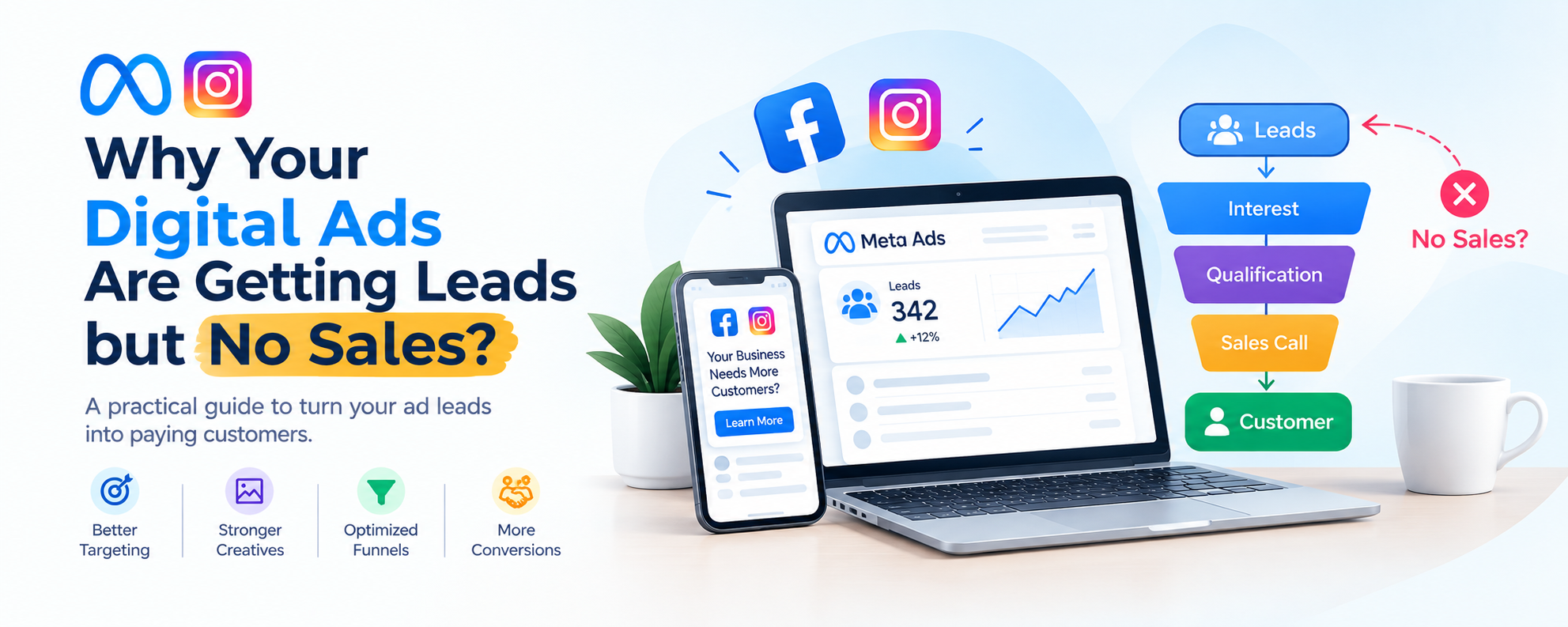
Generating leads is only the beginning.
A business also needs a process for turning those leads into customers.
Your lead generation system could include:
Advertisement → Landing Page → Lead Form → CRM/Spreadsheet → Sales Follow-Up → Conversion
Depending on your business, you can also use:
- Email marketing
- Phone calls
- CRM systems
- Automated responses
- Remarketing campaigns
Fast and consistent follow-up is particularly important for businesses where customers may contact multiple competitors before making a decision.
8. Use WhatsApp Marketing Carefully
For many Indian businesses, WhatsApp is an important communication channel.
Businesses can use WhatsApp to:
- Respond to enquiries
- Share product information
- Send quotations
- Answer customer questions
- Follow up with prospects
- Provide customer support
However, avoid sending unsolicited promotional messages. Use WhatsApp primarily with customers or prospects who have provided appropriate consent or initiated communication.
The objective should be to make communication easier, not to overwhelm customers with messages.
9. Use Remarketing to Reconnect With Potential Customers
Not every customer will purchase the first time they see your brand.
Someone might:
- Visit your website
- Watch your video
- View a product
- Interact with your Instagram page
- Start filling out a form
- Add an item to their cart
And then leave.
Remarketing allows businesses to reconnect with eligible audiences who have already interacted with their brand.
This can be particularly useful because these audiences have already demonstrated some level of interest.
10. Track Your Marketing Results
One of the biggest mistakes small businesses make is spending money on marketing without properly measuring the results.
Depending on your business model, important metrics may include:
- Website visitors
- Leads generated
- Cost per lead
- Conversion rate
- Customer acquisition cost
- Return on ad spend
- Sales
- Revenue
- Engagement
- Organic traffic
For example, getting 500 leads may sound impressive. But if only a small percentage become customers, the business needs to understand where the conversion process is breaking down.
Don't measure marketing only by likes and followers. Measure the business outcome.
11. Build a Strong Online Reputation
Trust plays an important role in purchasing decisions.
Before contacting a business, customers may check:
- Google reviews
- Website
- Testimonials
- YouTube
- Customer feedback
Encourage genuine customers to share honest reviews about their experiences.
At the same time, respond professionally to both positive and negative feedback.
A strong online reputation can support the other parts of your digital marketing strategy.
12. Automate Repetitive Marketing Tasks
As your business grows, manually handling every enquiry and marketing task can become difficult.
Marketing automation can help streamline repetitive processes such as:
- Lead notifications
- Follow-up reminders
- Email sequences
- Lead qualification
- Customer communication
- Reporting
- Data organization
Automation doesn't replace the human side of sales and customer service. Instead, it can help your team spend more time on high-value activities.
How Much Should a Small Business Spend on Digital Marketing?
There is no single marketing budget that works for every business.
Your budget should depend on:
- Industry
- Location
- Competition
- Average customer value
- Sales cycle
- Business goals
- Available resources
- Current online presence
A small business should generally start with a clearly defined objective rather than spending money across every platform simultaneously.
For example:
Goal: Generate local service enquiries
Strategy: Google Business Profile + Local SEO + Meta Lead Ads + Landing Page
Measurement: Qualified leads + Cost per qualified lead + Sales
This approach makes it easier to understand what is actually working.
Common Digital Marketing Mistakes Small Businesses Should Avoid
1. Trying Every Platform at Once
Being present everywhere isn't necessarily better. Focus on platforms where your target customers are actually active.
2. Posting Without a Strategy
Random posts may create activity but don't necessarily create business results.
3. Ignoring the Website
Sending paid traffic to a slow, confusing, or poorly designed website can waste advertising money.
4. Not Tracking Conversions
Without proper tracking, it becomes difficult to understand which campaigns generate actual business.
5. Focusing Only on Followers
A large follower count doesn't automatically mean more customers.
6. Stopping Ads Too Quickly
Some campaigns require testing and optimization before you can understand which audience, creative, offer, and message perform better.
7. Ignoring Existing Leads
Businesses often spend heavily on generating new leads while failing to follow up properly with the leads they already have.
A Simple Digital Marketing Framework for Small Businesses
If you're starting from scratch, you don't need an extremely complicated marketing system.
Start with this basic framework:
- Define your target customer
- Build a professional website
- Optimize your Google Business Profile
- Create consistent social media content
- Start SEO and content marketing
- Test Meta Ads or Google Ads
- Capture and follow up with leads
- Track conversions and revenue
- Optimize what is working
- Scale gradually
The goal isn't to do everything at once. The goal is to build a marketing system that can be measured, improved, and scaled.
Final Thoughts
Digital marketing gives small businesses the opportunity to build visibility and connect with potential customers online. But successful digital marketing isn't simply about running advertisements or posting regularly on social media.
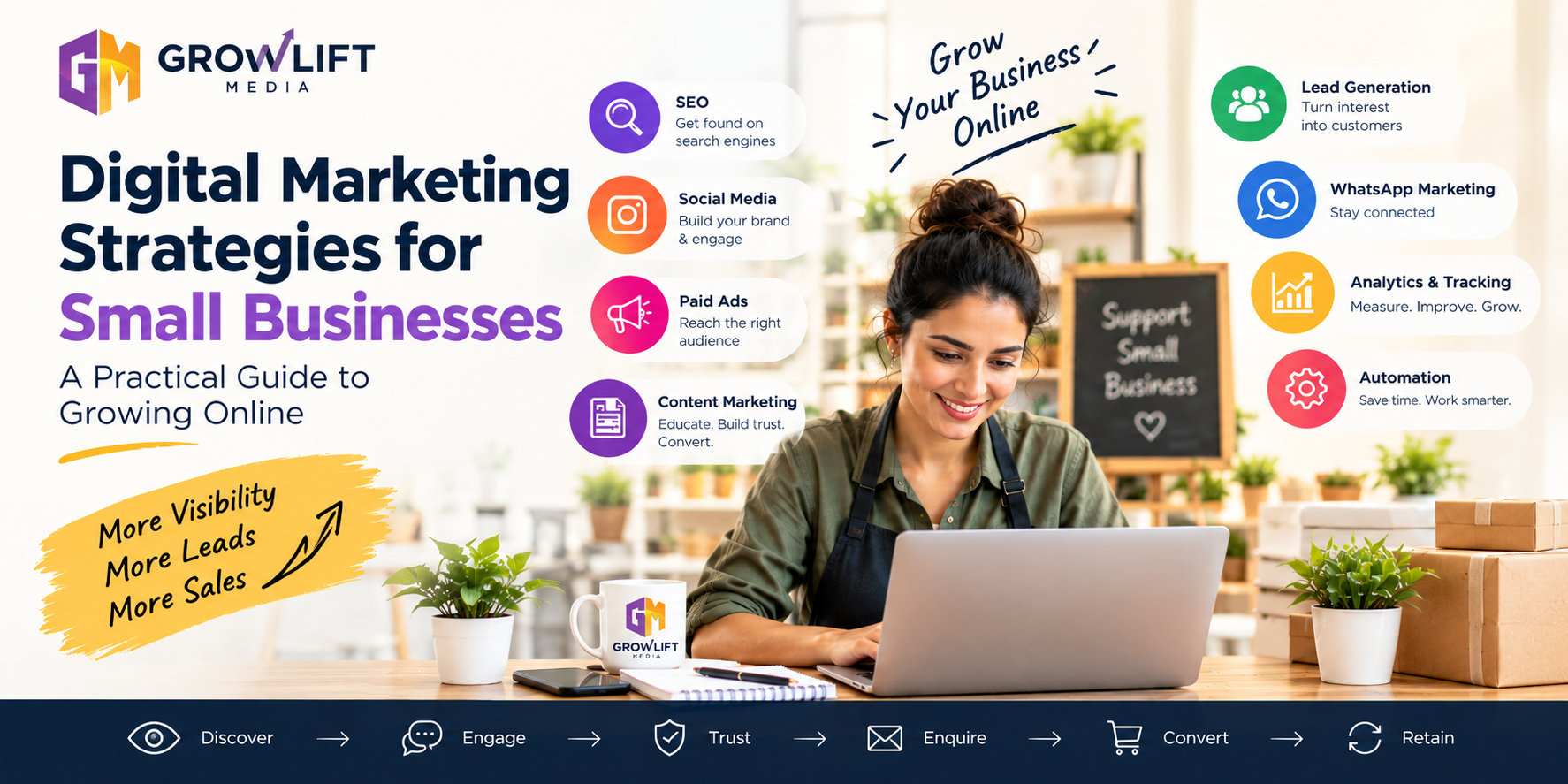
It's about creating a complete customer journey:
Discover → Engage → Trust → Enquire → Convert → Retain
From websites and SEO to social media, paid advertising, lead generation, automation, and analytics, every part of your digital presence should work toward a clear business objective.
At GrowLift Media, we help businesses build and improve their online presence through digital marketing, Meta Ads, lead generation, social media management, SEO, websites and landing pages, AI-powered lead automation, and e-commerce growth strategies.
Ready to Grow Your Business Online?
Connect with GrowLift Media and build a digital marketing strategy focused on visibility, leads, and measurable business growth.
Grow Your Business With GrowLift Media