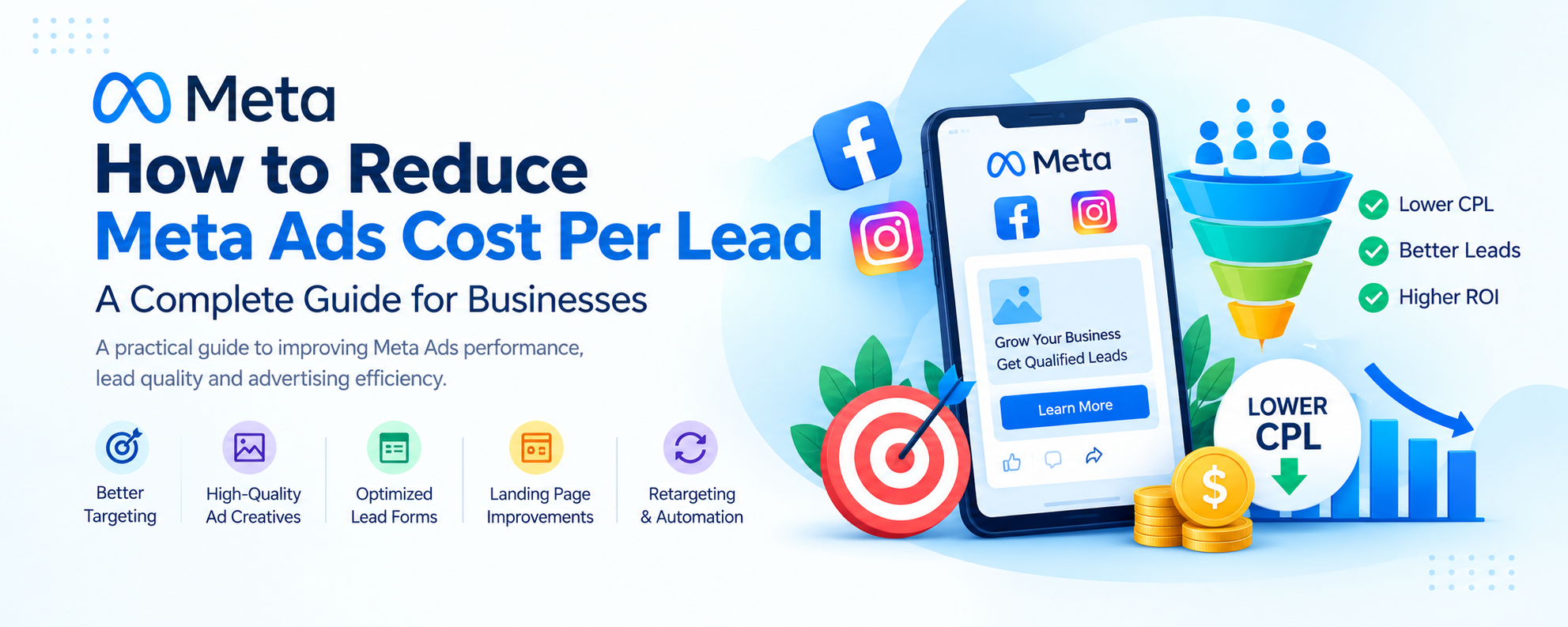
How to Reduce Meta Ads Cost Per Lead: A Complete Guide for Businesses
A practical guide to improving Meta Ads performance, lead quality and advertising efficiency.
Introduction
Running Facebook and Instagram ads can be one of the fastest ways to generate leads for your business. However, many businesses face a common problem: the Cost Per Lead (CPL) keeps increasing.
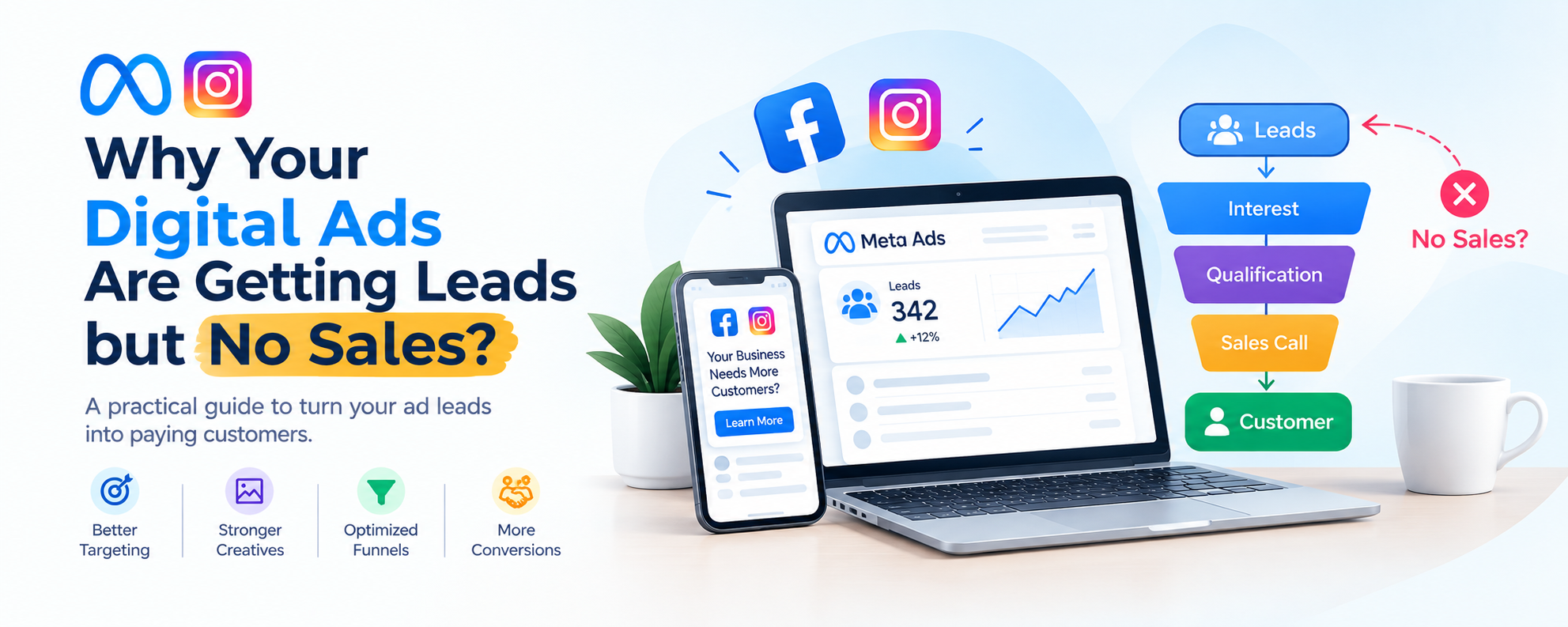
You may be getting leads, but if every lead costs too much—or the leads are not converting into customers—your advertising campaigns can quickly become unprofitable.
The good news is that a high Meta Ads Cost Per Lead is not always caused by your advertising budget. Your audience targeting, ad creative, offer, campaign structure, lead form, landing page and follow-up process can all affect your CPL.
In this guide, we'll explain practical strategies to help reduce your Meta Ads Cost Per Lead while focusing on attracting better-quality leads.
What Is Cost Per Lead in Meta Ads?
Cost Per Lead, commonly known as CPL, is the amount you spend to generate one lead.
Cost Per Lead = Total Ad Spend ÷ Number of Leads Generated
For example, if you spend ₹10,000 on Meta Ads and generate 100 leads, your Cost Per Lead is ₹100.
However, a lower CPL does not always mean a better campaign. If cheap leads are irrelevant while more expensive leads regularly become paying customers, the more expensive campaign may actually be more profitable.
That is why businesses should focus on Cost Per Qualified Lead, Cost Per Customer and Return on Ad Spend—not just the cheapest possible CPL.
1. Start With the Right Campaign Objective
If your goal is to collect leads, your campaign should be optimized for lead generation rather than simply getting website traffic, video views, post engagement or page likes.
When you optimize for traffic, Meta will generally try to find people more likely to click. When you optimize for engagement, it will generally look for people more likely to interact.
Make sure your campaign setup matches your actual business goal.
2. Improve Your Offer
Sometimes the problem isn't the Meta Ads campaign. The problem is the offer.
People need a good reason to submit their information.
Weak Offer:
“We Provide Digital Marketing Services. Contact Us Today.”
Stronger Offer:
“Want More Qualified Leads for Your Business? Get a Custom Digital
Marketing Strategy and Discover the Best Channels for Your Growth.”
Depending on your business, effective offers could include a quote, consultation, product demo, business audit, guide, customized strategy, site visit, eligibility check or project estimate.
Your offer should be relevant to your target customer and the service you are promoting.
3. Improve Your Ad Creative
Your ad creative is one of the first things potential customers see. If the creative doesn't capture attention or communicate your offer clearly, people may scroll past it.
Test short-form videos, Reels, static image ads, carousel ads, before-and-after visuals, customer testimonials, founder or expert videos, educational content and problem-and-solution creatives.
A good lead-generation creative should quickly answer:
- Who is this for?
- What problem does it solve?
- What is the benefit?
- Why should someone take action?
4. Test Multiple Ad Creatives
One of the biggest mistakes advertisers make is creating one ad and expecting it to perform forever.
Meta Ads performance can change because of audience saturation, ad fatigue, competition and changing customer behavior.
Test different hooks, visuals and messaging angles.
- “Struggling to generate quality leads?”
- “Stop spending on ads without tracking real results.”
- “Looking for more customers for your business?”
Continuous creative testing can help identify which messages and formats attract the right audience at a lower cost.
5. Target the Right Audience
Poor audience targeting can result in wasted advertising spend.
Before creating your campaign, clearly define who your ideal customer is, where they are located, what type of business they operate, what problem they face and what service they are likely to need.
Depending on your business, test broad audiences, interest-based audiences, custom audiences, website visitors, customer lists where appropriate, engaged social media audiences and lookalike or similar audiences where available.
Don't assume one audience will always perform best. Testing is important.
6. Avoid Over-Targeting Your Audience
Many advertisers make their audience too narrow by combining multiple interests, a narrow age range, specific behaviors and a small geographic area.
This can reduce available audience size and make delivery more difficult.
Instead, test broad targeting, relevant interest targeting and custom or remarketing audiences. Compare results based not only on CPL but also on lead quality.
7. Improve Your Ad Copy
A strong ad-copy structure is:
Hook
Capture attention by addressing a problem or opportunity.
Problem
Show that you understand the customer's challenge.
Solution
Explain how your product or service can help.
Call to Action
Tell the person what to do next.
Avoid making your ad copy unnecessarily long or complicated. Keep the message clear and easy to understand.
8. Optimize Your Meta Lead Form
If you're using Meta Instant Forms, the design of your form can affect both lead quantity and quality.
A very simple form may generate many cheap leads, but some may not be genuinely interested. Adding relevant qualifying questions can improve lead quality.
For example:
- What service are you interested in?
- What is your approximate budget?
- When are you planning to start?
- Which city is your business located in?
Be careful not to ask too many questions. The goal is to balance Lead Volume and Lead Quality.
9. Test Instant Forms vs Landing Pages
Meta lead generation campaigns can collect information directly through Instant Forms. However, for some businesses, sending users to a dedicated landing page may generate higher-quality leads.
Instant Forms reduce friction. Landing pages can provide more information about services, processes, portfolios, testimonials, pricing, estimates and FAQs.
Test both approaches where appropriate, especially for high-value services.
10. Use Retargeting Campaigns
Not everyone will become a lead after seeing your advertisement once.
Retarget people who have visited your website, engaged with Instagram or Facebook, watched your videos, opened but didn't submit a lead form, visited important service pages or previously contacted your business.
A simple funnel is:
Cold Audience → Educational Content
Engaged Audience → Case Study or Testimonial
Interested Audience → Consultation or Lead Offer
Retargeting allows you to build trust before asking for the lead.
11. Improve Your Landing Page Conversion Rate
If you're sending traffic from Meta Ads to your website, your landing page can have a major impact on CPL.
Include:
- Clear headline
- Strong value proposition
- Relevant visuals
- Benefits
- Testimonials
- Case studies
- Trust signals
- Clear CTA
- Simple lead form
- Mobile-friendly design
- Fast loading speed
The advertisement and landing page should have a consistent message. If your ad promises a free consultation, the landing page should clearly explain that same offer.
12. Improve Lead Response Time
Reducing CPL is important, but converting leads into customers is even more important.
If your team takes several hours or days to contact a lead, the prospect may lose interest or contact another company.
Create a fast follow-up system using CRM tools, WhatsApp automation, email automation, sales notifications, automated responses and follow-up reminders.
A good lead-generation system doesn't end when the form is submitted. It continues until the lead is properly followed up and qualified.
13. Use Conversion Tracking Properly
Without proper tracking, it is difficult to know what is actually working.
Track:
- Lead form submissions
- Calls
- WhatsApp inquiries
- Landing page conversions
- Purchases
- Qualified leads
- Sales
High Clicks + Low Leads
May indicate a landing-page or offer problem.
High Leads + Low Sales
May indicate a lead-quality, qualification or sales follow-up problem.
High CPL + Low Click-Through Rate
May indicate a creative, messaging or audience problem.
14. Monitor Ad Frequency and Creative Fatigue
If the same audience repeatedly sees the same advertisement, performance can decline over time.
Monitor:
- Rising CPL
- Falling click-through rates
- Reduced engagement
- Increasing frequency
When performance starts declining, test new ad creatives, hooks, offers, video formats and messaging angles. Regular creative refreshes can help maintain campaign performance.
15. Don't Edit Campaigns Too Frequently
Constantly changing campaigns makes it difficult to understand what is actually improving or hurting performance.
Instead of changing everything at once, test one important variable at a time:
- Different creative
- Different audience
- Different offer
- Different lead form
This makes it easier to identify which changes contribute to better results.
16. Focus on Cost Per Qualified Lead, Not Just CPL
A campaign with a low CPL may generate leads that don't answer calls, have no real requirement, don't have the required budget, are outside your service location or are simply looking for free information.
Instead, track:
Ad Spend → Total Leads → Qualified Leads → Sales Opportunities → Customers
Then calculate Cost Per Qualified Lead and Customer Acquisition Cost. This gives you a much clearer picture of campaign profitability.
A Simple Meta Ads Lead Generation Funnel
Target Audience
↓
High-Quality Ad Creative
↓
Relevant Offer
↓
Lead Form or Landing Page
↓
Lead Qualification
↓
Instant Follow-Up
↓
Sales Conversation
↓
Customer
Every stage affects the final result. If you only focus on reducing advertising cost without improving the rest of the funnel, you may generate cheap leads that don't produce revenue.
Common Reasons Why Meta Ads CPL Is High
- Weak Offer — People don't see enough value in submitting their information.
- Poor Ad Creative — The advertisement doesn't capture attention or communicate the offer clearly.
- Wrong Audience — Your ads are reaching people who are unlikely to need your service.
- Audience Too Narrow — Over-targeting can limit delivery opportunities.
- Weak Landing Page — Visitors click the advertisement but don't convert.
- Complicated Lead Form — Too many questions may reduce form completion.
- No Creative Testing — The same ad may become less effective over time.
- Poor Follow-Up — Even quality leads can be lost if the sales team responds slowly.
- No Retargeting — Potential customers may need multiple interactions before submitting an inquiry.
- Focusing Only on Cheap Leads — Low CPL does not automatically mean profitable advertising.
How Our Meta Ads and Lead Generation Services Can Help
Running Meta Ads successfully requires more than simply boosting a post or creating a basic lead campaign.
A well-planned lead-generation strategy can include:
- Audience research
- Competitor research
- Campaign strategy
- Meta Ads setup and management
- Creative strategy
- Ad copywriting
- Lead form optimization
- Landing page strategy
- Retargeting campaigns
- Conversion tracking
- Lead qualification
- Performance analysis
- Creative testing
- Campaign optimization
Our goal is not simply to generate more form submissions. We focus on building a complete lead-generation system designed to help businesses attract relevant prospects and improve the efficiency of their marketing spend.
Final Thoughts
Reducing your Meta Ads Cost Per Lead is not about finding one secret targeting option or constantly lowering your budget.
It requires testing and improving the complete customer journey.
The most effective approach is to focus on:
The Right Audience + Strong Offer + High-Quality Creative +
Clear Messaging + Optimized Lead Form + Effective Landing Page +
Retargeting + Fast Follow-Up + Proper Tracking
Remember: The cheapest lead is not always the best lead.
A successful Meta Ads campaign should ultimately help your business generate qualified opportunities and customers—not just low-cost form submissions.
Need Help Reducing Your Meta Ads Cost Per Lead?
Our team helps businesses create and optimize lead-generation campaigns through Meta Ads, Google Ads, landing pages, creative strategy, conversion tracking, retargeting and lead automation.
If you're looking to generate more relevant leads and improve the efficiency of your advertising budget, a well-planned digital marketing strategy can help.
Get in touch with our team to discuss a lead-generation strategy for your business.
Get Started