Introduction
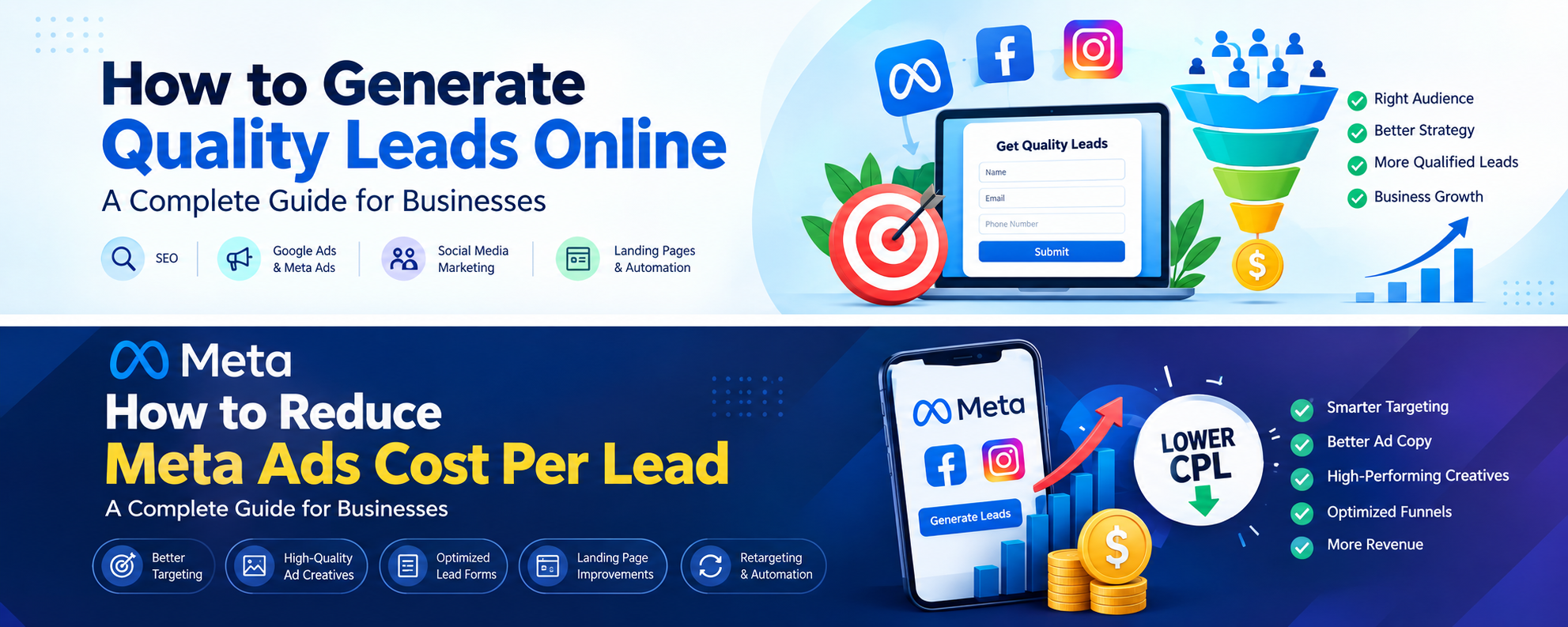
Generating leads online is no longer just about getting more website visitors or running advertisements. The real challenge is generating quality leads—people who are genuinely interested in your product or service and have a higher chance of becoming paying customers.
Whether you run a local business, B2B company, e-commerce brand, real estate business, interior design firm, professional service, or startup, having a proper online lead generation strategy can help you build a predictable sales pipeline.
In this guide, we'll explain how businesses can generate quality leads online using proven digital marketing strategies.
What Is a Quality Lead?
A quality lead is a potential customer who:
- Has a genuine interest in your product or service
- Matches your target audience
- Has a specific requirement or problem
- Has the purchasing ability or intent
- Is willing to communicate with your business
- Has a reasonable chance of becoming a customer
For example, if you are an interior design company, getting 100 inquiries from people looking for free design ideas may not be as valuable as getting 10 inquiries from homeowners who are actively planning an interior design project.
The goal isn't simply to generate more leads. The goal is to generate better leads.
1. Define Your Ideal Customer
Before spending money on advertising, you need to understand exactly who you want to attract.
Create an Ideal Customer Profile (ICP) based on factors such as:
- Age
- Location
- Profession
- Income
- Business size
- Industry
- Buying behavior
- Problems and requirements
- Budget
- Purchase intent
For B2B businesses, you should also consider company size, decision-maker, industry, annual revenue, job title and business requirements.
The more clearly you understand your ideal customer, the easier it becomes to create targeted campaigns.
2. Build a High-Converting Website
Your website is often the first place potential customers go after discovering your business.
A good website should not only look professional—it should also convert visitors into leads.
Make sure your website includes:
- Clear value proposition
- Strong headlines
- Simple navigation
- Mobile-friendly design
- Fast loading speed
- Service/product information
- Customer testimonials
- Case studies
- Trust signals
- Clear Call-to-Action (CTA)
- Contact forms
- WhatsApp or direct communication options
Instead of using a generic CTA like "Learn More," you could use "Get a Free Strategy Call," "Request a Quote," or "Book a Consultation." Your CTA should tell visitors exactly what they should do next.
3. Use SEO to Generate Organic Leads
Search Engine Optimization (SEO) is one of the most powerful long-term lead generation strategies.
When potential customers search Google for a service, appearing on the first page can bring highly relevant traffic to your website.
For example, a digital marketing agency could target keywords such as:
- Digital marketing agency
- Digital marketing agency in Delhi
- Lead generation agency
- Social media marketing agency
- Google Ads agency
- Meta Ads agency
- SEO company
- E-commerce marketing agency
- Amazon marketing agency
The important thing is to target search intent, not just high-volume keywords.
Someone searching "What is digital marketing?" may only be researching. Someone searching "digital marketing agency in Delhi" is much more likely to be looking for a service provider.
Therefore, businesses should create content for different stages of the customer journey.
4. Run Targeted Meta Ads
Facebook and Instagram advertising can be highly effective for generating leads when campaigns are properly targeted.
With Meta Ads, businesses can target audiences based on location, age, interests, behaviors, demographics, previous website visitors, customer lists, engagement and similar audiences.
However, targeting alone doesn't guarantee quality leads.
Your ad creative, offer, landing page, lead form and follow-up process all influence lead quality.
Instead of simply advertising "We provide interior design services," create an offer around a specific customer problem, such as "Planning Your Home Interior? Get a Professional Design Consultation."
This attracts people who have an actual requirement rather than random users.
5. Use Google Ads to Capture High-Intent Leads
Google Ads can be particularly powerful because you can reach people when they are actively searching for a product or service.
For example, someone searching "best digital marketing agency in Delhi" already has commercial intent. Similarly, "interior designer in Gurgaon" can indicate that the person is actively looking for an interior designer.
Businesses should carefully select commercial and transactional keywords.
You should also use:
- Negative keywords
- Location targeting
- Conversion tracking
- Call tracking
- Landing pages
- Ad extensions/assets
- Conversion-focused ad copy
These can help reduce irrelevant traffic and improve lead quality.
6. Create Dedicated Landing Pages
One of the biggest mistakes businesses make is sending every advertisement to their homepage.
Instead, create a dedicated landing page for each major campaign or service.
Ad → Digital Marketing Landing Page → Lead Form
A good landing page should include:
- Strong headline
- Clear benefits
- Social proof
- Testimonials
- Client logos
- Case studies
- Clear CTA
- Simple form
Don't ask for unnecessary information. A shorter form can increase conversions, while additional qualifying questions can be useful when lead quality is more important than lead volume.
7. Use Lead Magnets
A lead magnet is something valuable you offer in exchange for a person's contact information.
Examples include:
- Free consultation
- Industry report
- E-book
- Checklist
- Audit
- Calculator
- Free quotation
- Strategy session
- Product demo
- Sample
- Case study
For example, a digital marketing agency could offer "Get a Free Digital Marketing Audit for Your Business."
The key is to make the lead magnet relevant to the service you sell.
8. Use Social Media Content to Build Trust
Not every customer is ready to purchase immediately. This is where social media content becomes important.
Create content that demonstrates your:
- Expertise
- Experience
- Results
- Process
- Knowledge
- Customer success stories
Content ideas include:
- Educational Reels
- How-to videos
- Case studies
- Before-and-after content
- Industry tips
- FAQs
- Client testimonials
- Behind-the-scenes content
- Common mistakes
- Expert opinions
Instead of constantly saying "Buy from us," educate your audience and demonstrate why your business is worth trusting.
9. Qualify Your Leads
Generating 1,000 leads doesn't mean you have generated 1,000 good opportunities.
Lead qualification is extremely important.
You can qualify leads using questions such as:
- What service are you interested in?
- What is your estimated budget?
- When do you want to start?
- What is your location?
- What is your business type?
- What problem are you trying to solve?
For example, instead of a simple Name + Phone Number form, ask what service the prospect is interested in. This helps your sales team understand the prospect before contacting them.
10. Use WhatsApp and Lead Automation
Speed matters in lead generation.
If someone submits a form today and your team contacts them three days later, they may already have chosen another company.
Businesses can use automation to:
- Send instant WhatsApp messages
- Send confirmation emails
- Notify the sales team
- Assign leads to sales representatives
- Schedule follow-ups
- Track lead status
- Send reminders
A CRM combined with automation can help businesses manage leads more efficiently.
11. Retarget Website Visitors
Many people won't convert during their first visit.
Retargeting allows businesses to reconnect with people who have previously interacted with their brand.
You can retarget people who:
- Visited your website
- Viewed a product
- Watched your video
- Engaged with Instagram
- Engaged with Facebook
- Started but didn't complete a form
- Added products to their cart
A simple journey can be:
First interaction → Educational content
Second interaction → Case study
Third interaction → Offer/consultation
Second interaction → Case study
Third interaction → Offer/consultation
This creates multiple opportunities to convert the prospect.
12. Build Trust Before Asking for the Sale
People don't buy simply because they see an advertisement. They buy when they trust the business.
Build credibility through:
- Google reviews
- Client testimonials
- Case studies
- Portfolio
- Certifications
- Industry experience
- Transparent pricing where appropriate
- Educational content
- Results and data
- Professional website
For high-value services, trust can have a major impact on conversion rates.
13. Track Your Lead Generation Performance
You cannot improve what you don't measure.
Important metrics include:
- Leads Generated — Total number of leads
- Cost Per Lead — Cost of acquiring one lead
- Lead-to-Customer Rate — Percentage becoming customers
- Conversion Rate — Percentage taking the desired action
- Customer Acquisition Cost — Cost of acquiring a customer
- ROAS — Return from advertising spend
- Qualified Lead Rate — Percentage of leads meeting your criteria
Don't judge a campaign only by its Cost Per Lead (CPL).
A campaign generating leads at ₹100 each may look better than one generating leads at ₹300 each. But if the ₹100 leads never purchase and the ₹300 leads regularly become customers, the second campaign may actually be more profitable.
14. Combine Multiple Lead Generation Channels
The strongest lead generation strategies usually don't depend on one channel.
A business can combine:
SEO + Google Ads + Meta Ads + Social Media + Landing Pages +
CRM + WhatsApp Automation + Remarketing
Each channel can serve a different purpose.
- SEO → Long-term organic traffic
- Google Ads → Capture high-intent searches
- Meta Ads → Generate and nurture demand
- Social Media → Build authority and trust
- Landing Pages → Convert traffic
- CRM → Manage leads
- Automation → Improve follow-up
This creates a complete digital lead generation ecosystem.
Common Lead Generation Mistakes
Businesses often struggle with lead generation because of a few common mistakes:
- ❌ Targeting everyone — Trying to sell to everyone usually results in poor-quality leads.
- ❌ Focusing only on cheap leads — Low CPL doesn't always mean good performance.
- ❌ Sending traffic to the homepage — Dedicated landing pages often provide a more focused conversion experience.
- ❌ Poor follow-up — Even good leads can be lost if the sales team responds slowly.
- ❌ No tracking — Without proper conversion tracking, you don't know which campaigns actually generate revenue.
- ❌ Weak offers — People need a reason to take action.
- ❌ No retargeting — You're leaving potential customers behind after their first interaction.
How Much Does Online Lead Generation Cost?
There is no fixed cost for generating leads online.
The cost depends on factors such as:
- Industry
- Location
- Competition
- Target audience
- Product/service price
- Advertising platform
- Offer
- Landing page quality
- Sales process
- Lead qualification
A highly competitive industry may have a much higher cost per lead than a less competitive market.
Therefore, businesses should focus on cost per qualified lead and cost per customer, rather than simply chasing the lowest possible CPL.
A Simple Online Lead Generation Funnel
A basic lead generation funnel can look like this:
Audience
↓
Advertisement / Google Search / Social Media / SEO
↓
Landing Page
↓
Lead Form / WhatsApp / Call
↓
Lead Qualification
↓
Sales Follow-Up
↓
Customer
↓
Repeat Customer / Referral
Every stage should be optimized.
If you are getting traffic but no leads, your landing page may need improvement.
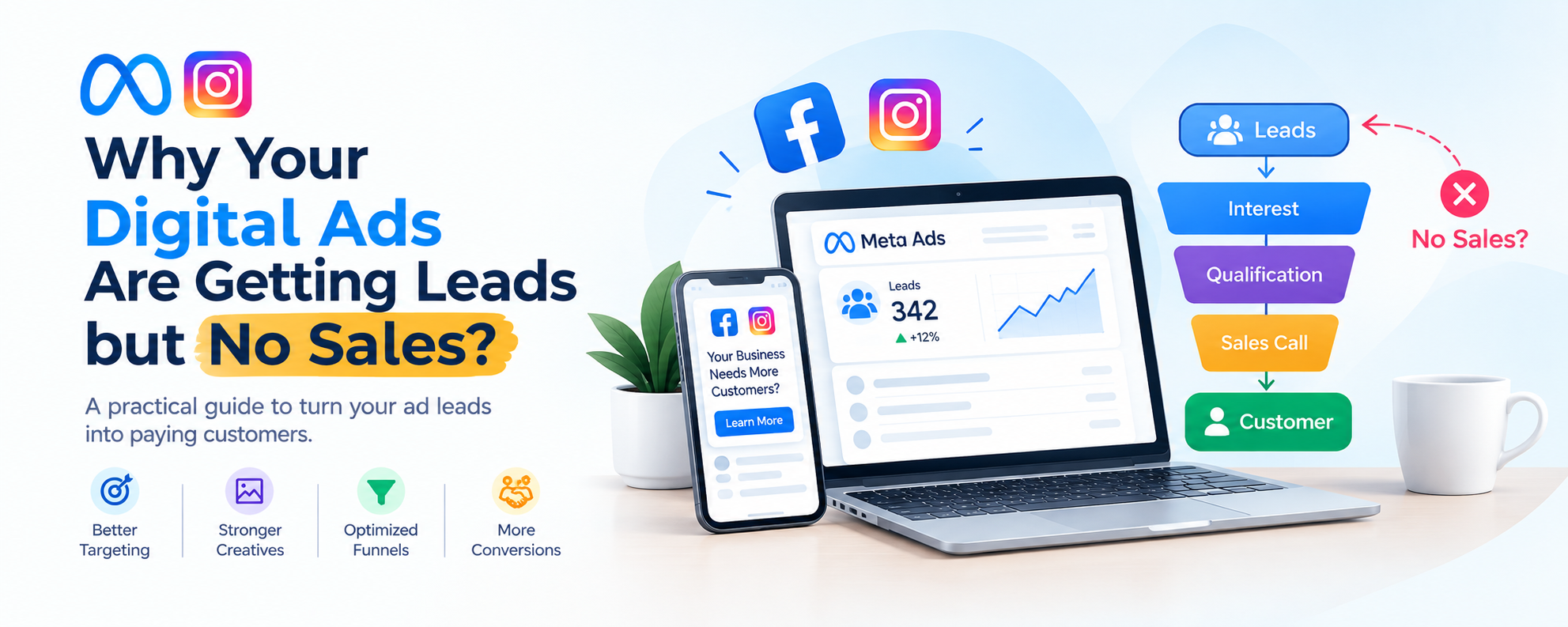
If you're getting leads but no customers, your qualification or sales process may need improvement.
Final Thoughts
Generating quality leads online is not about using one magic advertising platform.
It requires a combination of the right audience, strong messaging, compelling offers, conversion-focused landing pages, effective advertising, SEO, social media, lead qualification, automation and consistent follow-up.
The businesses that succeed online are the ones that focus on the entire customer journey—not just the number of leads generated.
If your business is struggling to generate consistent, high-quality leads, a professionally planned digital marketing strategy can help you identify the right channels, target the right audience and build a system that turns online traffic into real business opportunities.
Looking to Generate More Quality Leads for Your Business?
Our digital marketing team can help businesses with lead generation, Meta Ads, Google Ads, SEO, social media marketing, landing pages, website development, e-commerce marketing and lead automation.
Whether you're a local business, startup, B2B company, professional service provider or e-commerce brand, the right strategy can help you build a more predictable flow of potential customers.
Ready to Turn Your Online Presence Into a Lead-Generating System?
Get in touch with our team today.
Get Started